Fairphone’s public information points to a different kind of phone-buying decision. Rather than treating a handset only as a specification comparison, it puts repair routes and replaceable parts at the centre of ownership. That can be meaningful for a buyer who wants a more maintainable device, but it does not answer every practical question. Before ordering in the UK, check the live product page, checkout terms, the repair guide for the model you are considering, and current parts stock.
Fairphone at a glance
AI-generated generic editorial illustration — not a retailer product photo and does not depict the reviewed product or service. Help readers compare practical options without depicting a product.
 Fairphone currently lists three smartphone routes on its website: the Fairphone (Gen. 6), a refurbished Fairphone (Gen. 6), and a Fairphone (Gen. 6) with /e/OS. The published reference prices shown on the site are €549 for the standard Gen. 6, €499 for the refurbished option, and €599 for the /e/OS version. These are useful starting points for comparing the range, but they are merchant-published figures rather than confirmed UK checkout prices. Currency, delivery, taxes, promotions and model availability should all be checked when you are ready to buy.
The important distinction is that this is not a conventional performance review. The supplied official information does not establish comparative camera quality, gaming results, real-world battery life, network performance, drop durability or long-term software-support comparisons. It does, however, show an ownership model built around repair guidance, a service route and a public spare-parts catalogue.
That makes Fairphone most relevant to buyers who place repairability and the ability to plan maintenance alongside the usual price and feature checks. A refurbished route may also be worth comparing if the initial price matters, although the choice should still be based on the current product listing and its terms. If you need independently verified performance data or an exact comparison of support duration before choosing a phone, seek that information separately rather than assuming modularity answers it.
Repair support and modular ownership
AI-generated generic editorial illustration — not a retailer product photo and does not depict the reviewed product or service. Make the documented repair options immediately scannable without implying independent repair testing.
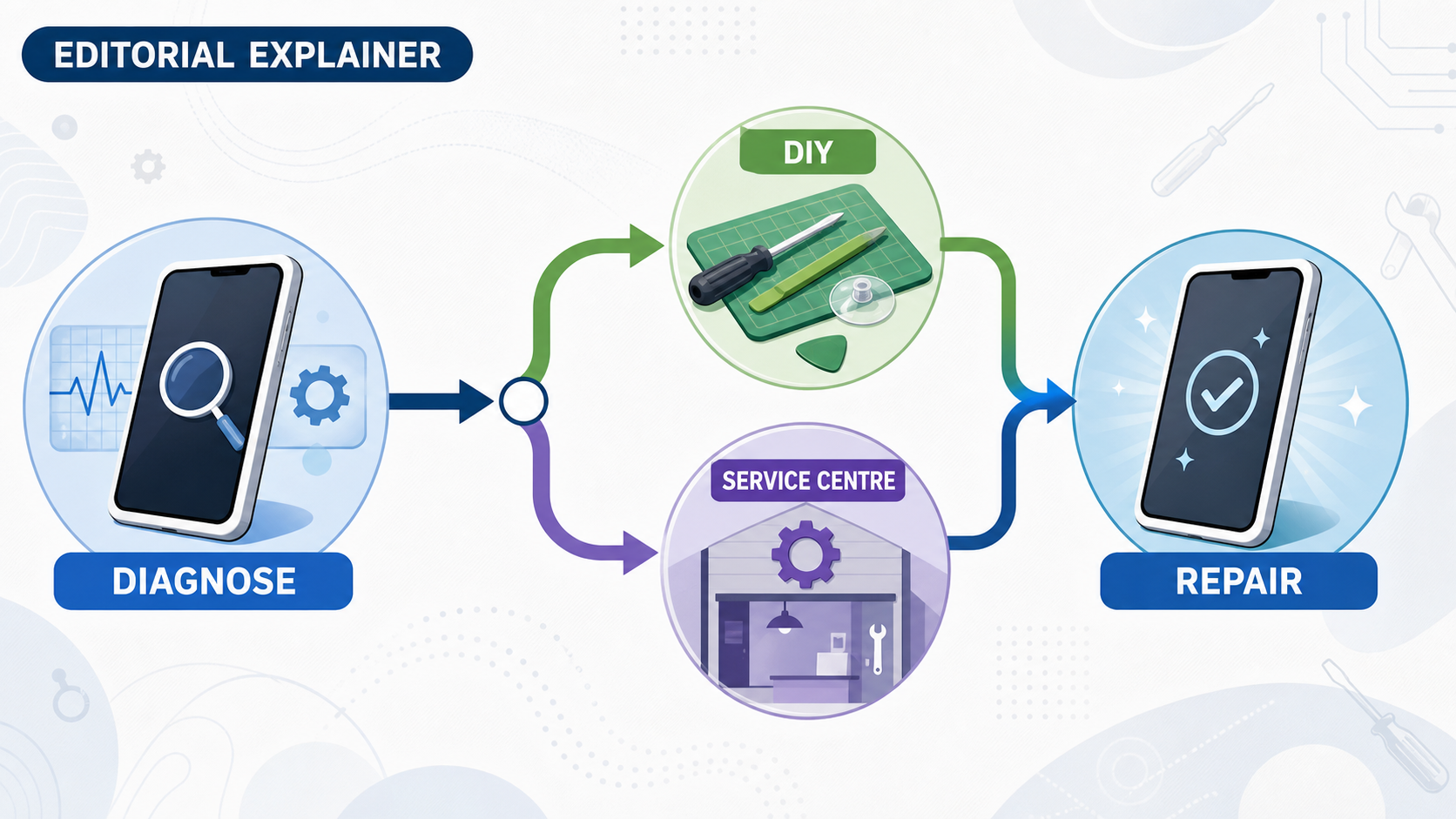 Fairphone’s official repair process begins with diagnosis. After that, the company presents two possible paths: send the device to a service centre or carry out a DIY repair. Its guidance says a service-centre route can be the better option when a problem is too complex for DIY work. The service centre will assess the issue in more detail, explain next steps and identify any costs before proceeding; Fairphone says non-warranty work requires the customer’s approval.
For a home repair, Fairphone lists three essentials: the relevant spare part, a Phillips 00 or Torx T5 screwdriver, and the appropriate repair guide. That is a practical advantage over a phone with no clearly presented repair route, but it is not a promise that every fault is easy to fix. Diagnosis still matters, both because the fault may need professional assessment and because some repairs may be covered by warranty.
The Gen. 6 repair page gives examples of the jobs Fairphone presents as user-serviceable. It lists battery replacement at around five to 10 minutes, display replacement at around 10 to 15 minutes, and camera-and-earpiece replacement at around 10 to 15 minutes. It also lists top-unit replacement and loudspeaker-and-USB-C-port work among its repair-guide options. These timings describe the manufacturer’s guidance, not an independent test of how long a first-time repair will take.
For a buyer, the useful takeaway is to treat repairability as a process rather than a slogan: identify the issue, read the model-specific guide, confirm the part is available, and decide whether the job is realistic for you. If not, use the service route instead of forcing a DIY repair.
Spare parts availability and repair costs
Fairphone’s spare-parts shop makes several common maintenance components visible before a repair is needed. Its listings include batteries, USB-C ports, displays, cameras, back covers and screw kits. That catalogue can make future maintenance easier to plan because you can see the type of component offered and its currently published starting price.
Examples on the supplied listing include a battery from €39.95, a USB-C port from €19.95, a display from €99.95, an ultra-wide camera from €44.95, a back cover from €24.95 and a screw kit from €9.95. These figures are component-level starting prices, not an estimate of a complete repair. A repair may also require a different part, tools, a service assessment, shipping or other costs depending on the diagnosis.
Availability is not fixed. The supplied shop page marks the main camera as out of stock, while also offering a notification option. This is a useful reminder that visible parts access does not guarantee that every part will be immediately orderable when you need it. The shop shows a United Kingdom pricelist option, but buyers should still verify the selected device, current UK stock, final price and delivery details at the point of purchase.
Practical limitations to consider
Modular ownership has clear boundaries. The official information supplied here supports claims about Fairphone’s repair journey, DIY prerequisites, service-centre assessment and the existence of listed spare parts. It does not substantiate a comparative verdict on camera output, gaming capability, battery endurance, network behaviour, durability, or long-term software support. Those are separate buying questions and should not be inferred from the repair proposition.
DIY is also conditional. You need a diagnosis, the correct part, suitable screwdriver and the relevant repair guide. Even where Fairphone lists a short estimated time for a task, that does not mean the repair is the right answer for every symptom or every owner. A complex issue may need the service-centre route, where further assessment determines what should happen next.
Costs are conditional too. Fairphone says some repairs are covered by warranty and others are not; where costs apply, it says it will keep the customer informed and obtain approval before going ahead. That means there is no single published repair-cost conclusion that fits every fault. Check warranty eligibility and the proposed repair outcome for your own device rather than treating a listed part price as a final bill.
Finally, parts visibility is not the same as constant availability. The out-of-stock main-camera listing is direct evidence that stock can vary. Choose the specific model and parts path you are comfortable with, then recheck live availability before relying on a future DIY plan.
Who should consider Fairphone
Fairphone is best considered by a buyer who wants a phone ownership model with documented repair options and visible spare-parts categories, and who is willing to make maintenance part of the purchasing decision. That buyer should compare the standard Gen. 6, the refurbished Gen. 6 and the /e/OS version using the current product pages, then confirm the live UK checkout price rather than relying on the published euro reference figures.
Before ordering, look at the repair guide for the exact device you are considering. If repairability is central to your decision, check whether the likely parts you care about are presently listed and in stock, and decide honestly whether you would be comfortable following a DIY guide with the required part and screwdriver. If that is not appealing, assess the service-centre route and its warranty and approval process instead.
A refurbished option may suit someone who prefers a lower listed starting price, while a new model may suit someone who wants to compare the current range first. Neither route removes the need to check live availability and terms. Avoid trying to calculate a universal lifetime saving from the parts catalogue: the supplied evidence does not establish how often a repair will be required, what each individual repair will cost, or how long any buyer will keep the device.
If your priority is independently tested performance, exact network compatibility, or a confirmed long-term software-support comparison, obtain those answers before purchase. Fairphone’s documented repair proposition can be a strong part of the decision, but it should sit alongside—not replace—the checks that matter for your everyday use.
Next step: Check current Fairphone options
Frequently Asked Questions
Can I repair a Fairphone myself?
Fairphone presents a DIY route after you diagnose the issue. Its guidance says you need the relevant spare part, a Phillips 00 or Torx T5 screwdriver, and the correct repair guide. The company lists Gen. 6 guides for jobs including battery, display, cameras-and-earpiece, top-unit, and loudspeaker-and-USB-C-port replacement. DIY is not necessarily appropriate for every fault, so use diagnosis first and choose the service-centre route if the issue is more complex.
What spare parts does Fairphone list for its phones?
The supplied Fairphone shop listing includes batteries, USB-C ports, displays, cameras, back covers and screw kits. It also shows published starting prices for selected components. The exact part you need depends on the device and diagnosis, so select your model in the shop and confirm the current listing before making a repair plan.
Are Fairphone spare parts always in stock?
No. The supplied listing identifies a main camera as out of stock and offers a notification option. Stock can therefore change, even when a component appears in the public catalogue. Check the live listing for the exact device and part before depending on a DIY repair route.
Should I choose a new or refurbished Fairphone?
Fairphone lists both a new Fairphone (Gen. 6) and a refurbished Fairphone (Gen. 6), with different published euro reference prices. Compare the current product details, UK checkout price and availability for both options. If maintainability is important, also review the relevant repair guide and current parts stock; if performance or support duration is decisive, verify those points through suitable current evidence before ordering.
Sources
Related reading
- Best smartphone brands for UK buyers: Apple, Samsung, Motorola and Fairphone compared for long-term ownership
- Motorola smartphone ownership review: current range, support routes and practical limits
- How to choose a smartphone for your needs: priorities, support, repairability and ownership cost
- How software support and repair options shape a smartphone's useful life
Editorial information: About our editorial team · Read our editorial policy · Read our affiliate disclosure.